
Introduction
Before a patient ever sits in your exam chair, they've already formed an opinion about your practice. It happens at the window.
Many practice owners struggle with the same tension: how do you grab attention from the sidewalk without turning a healthcare space into a billboard? Frames are small, lenses need context, and the storefront still has to feel trustworthy, not just eye-catching.
Industry guidance consistently points to the window as that first touchpoint, the moment a passerby decides whether to keep walking or come inside, according to 20/20's practice guidance.
This guide covers the display formats available, design principles specific to eyewear, what digital signage actually requires, and how to measure whether your window is doing its job.
Key Takeaways
- Effective windows combine merchandising, lighting, and one clear message, not just frames behind glass
- One dominant idea beats five competing offers every time
- Digital displays add motion and flexibility but demand planning for glare, power, and content updates
- The window should feel like a preview of the interior, not a separate advertisement
What Are Optical Window Displays?
An optical window display is any static, illuminated, digital, or hybrid presentation positioned in a practice's storefront glass to attract attention and communicate a single product, service, or brand message. That's the broad definition. In practice, it takes a few distinct shapes.
Three Formats, One Goal
- Traditional merchandising displays use physical frames, props, and printed graphics arranged behind the glass
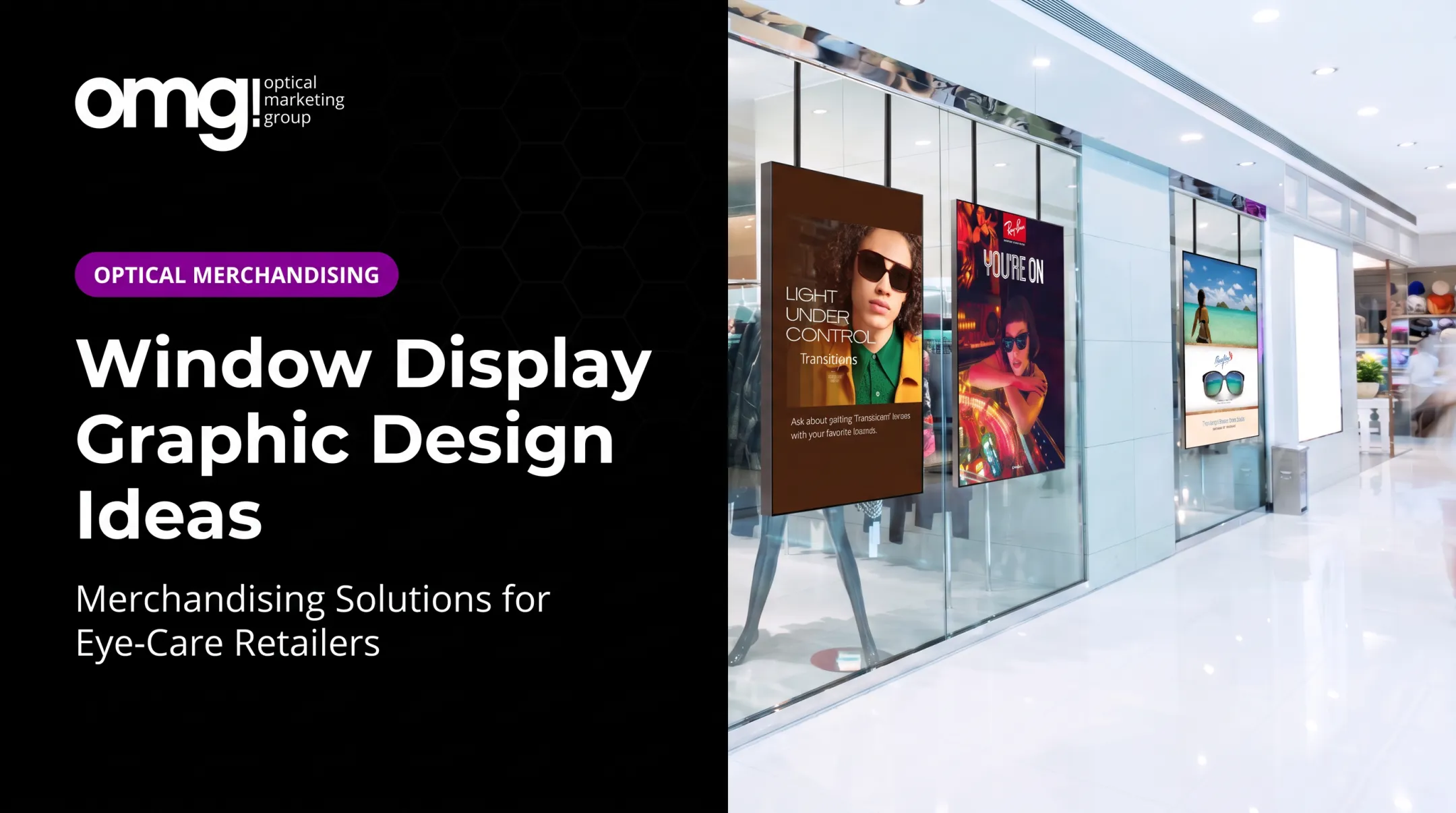
- Window-facing digital screens sit behind the glass and run managed content, like OMG's HD Series window-facing digital signage, built for visibility even in full sunlight
- Transparent or see-through displays keep products or the interior visible while adding a message layer
Optical retail isn't general retail. Frames are small and delicate, lenses often need a sentence of explanation, and the whole thing still has to read as clinically credible, not just commercially loud.
Why It's Harder Than It Looks
A sweater display can lean entirely on lifestyle imagery. A frame can't. It needs scale, lighting, and context to register from six feet away through glass.
That's part of why less than 5% of optical retailers currently have proper signage throughout their facility, according to OMG's internal New Rules research. Without it, patients struggle to identify specific brands and categories even once they're inside.
The right format for your practice depends on a handful of practical constraints:
- Window size and street visibility
- Viewing distance (foot traffic versus drive-by)
- Daylight exposure and glare at different times of day
- Available power and cable routing
- Brand standards and refresh frequency
Get these right first. Everything else builds on top of them: color, lighting, and messaging.
What Are the 7 Types of Window Displays?
There's no official industry standard here, but seven practical categories cover most optical storefronts. Many projects blend two or three rather than sticking to one.
| Type | Optical Example | Best Suited For |
|---|---|---|
| Product-focused | A curated frame or sunglass collection as the visual centerpiece | Attracting new foot traffic |
| Lifestyle | Eyewear shown in a relatable scenario, like travel or outdoor activity | Building emotional connection |
| Brand-led | A manufacturer's campaign assets, such as the Transitions "WOW Display" program | Reinforcing vendor partnerships |
| Educational | A simple callout explaining a lens coating or UV benefit | Supporting patient understanding |
| Seasonal/promotional | A back-to-school or sun-protection themed window | Timing offers to buying cycles |
| Graphic/illuminated | Dimensional lettering, lightboxes, or printed panels for nighttime visibility | Extending visibility after hours |
| Digital/interactive | A window-facing screen running rotating campaigns | Delivering more content than static glass allows |
Digital adoption at scale isn't hypothetical. Luxottica reported roughly 20,000 installed digital windows worldwide, according to Vision Monday's 2019 coverage, showing how far large eyewear brands have pushed screen-based storefronts.
That scale doesn't mean every practice needs a screen. A well-lit frame arrangement with a single printed callout can outperform a cluttered digital loop. The "best" type depends entirely on your audience and storefront context, not a checklist.
A few practical notes before committing to a type:
- Manufacturer-branded displays often require approval before installation
- Promotional signage may carry specific offer terms that need updating on schedule
- Local sign ordinances can restrict illuminated or digital formats, so check before ordering
How to Design an Optical Window Display That Works
Pick One Message
Trying to promote three frame brands, a lens offer, and a seasonal sale in one window creates visual noise. The viewer's brain can't sort it, so it processes none of it. Choose one objective, one dominant message, and let everything else support it.
Build a Hierarchy, Then Light It
A flat row of frames reads as inventory, not a display. Instead:
- Set one focal point at eye level
- Stagger supporting products at varied heights
- Leave genuine negative space around the hero item
Lighting carries more weight than most practices budget for. OMG's internal data on recent build-outs shows at least 30% of a build-out budget now goes toward lighting, which heavily shapes perceived quality.
Color and contrast need to survive real-world glare, not just look good on a mood board. Test visibility against both morning sun and evening reflections, since what reads clearly at 10 a.m. can disappear at 5 p.m.
Keep It Legible for Everyone
Window copy should pass a basic accessibility check: readable type size, strong contrast, and plain language that doesn't rely solely on color or fast motion to land the point.
Promotional window graphics and required facility signage aren't governed identically. Under the ADA's accessibility standards, required informational and directional signage must meet contrast and glare provisions, but company names and logos are explicitly exempt.
Keep that distinction in mind when a landlord or inspector asks about compliance.
Connect the Window to the Interior
If the window promises a premium frame collection and the dispensary inside looks dated, the gap kills trust fast. Repeat materials, typography, and campaign themes from window to floor so the storefront feels like a preview, not a separate advertisement.

Refresh and Evaluate on a Real Schedule
Base your refresh timing on campaign cycles, new arrivals, and seasonality, not an arbitrary calendar date. Then watch for signals that the window is working:
- Staff fielding questions about the featured product
- QR code scans tied to a specific campaign
- Noticeable shifts in window-to-entry behavior
Establish a baseline before drawing conclusions. A quiet week could be weather, not messaging.
Planning Technology, Content and Installation
Behind Glass Versus Fully Outdoor
A screen installed inside the practice and viewed through glass faces different demands than a unit mounted outdoors. Behind-glass units still need enough brightness to beat daytime glare, plus ventilation, since heat builds up fast in a closed window bay.
OMG's 55-inch Ultra Bright Window TV, for example, runs at 2,500 cd/m² brightness with an operating range of 0°F to 122°F. It supports portrait or landscape orientation and mounts via suspended wire or ceiling hang.
That brightness-and-range profile is what window-facing hardware generally needs. Truly outdoor units require additional weatherproofing that this kind of indoor-facing display doesn't.
Content Planning Checklist
Before a screen goes live, settle these details:
- Orientation and duration - how long each message holds before rotating
- Legibility - does video text read clearly through glass and reflections?
- Approvals - who signs off on brand or manufacturer content?
- Scheduling - who owns updates, and how often do they happen?
- Failover - what shows if the network or media player drops?
A system like OMG's Contentlinq platform covers these needs with cloud-based updates, playlist creation, and engagement analytics, so content doesn't rely on someone physically swapping a USB drive.
Where OMG Fits
OMG! Optical Marketing Group built its Patient Experience Assessment and Project Planner to help practices coordinate window displays with the rest of the patient journey. Storefront, fixtures, signage, and interior layout get planned together instead of as separate purchases.
What Drives Cost
Project pricing varies with:
- Display size and quantity
- Static versus digital technology
- Custom fixtures and graphic production
- Installation access and electrical work
- Content creation and ongoing software subscriptions
Request a concept, technical spec, installation scope, and content plan before approving anything, especially for multi-location practices that need repeatable standards across sites.
After install, test the finished display from the actual sidewalk or street approach at different times of day. Check reflections, sightlines, and whether the message still lands within a three-second glance.

Frequently Asked Questions
How much does a window display cost?
Cost depends on static versus digital format, size, materials, lighting, custom fixtures, installation, and ongoing content or software needs. Request a project-specific scope rather than relying on a flat industry price.
What is a window display?
A window display is a curated storefront presentation used to attract attention and communicate products, services, or a brand message. Formats include static, illuminated, digital, and hybrid setups.
What are the 7 types of window displays?
Product-focused, lifestyle, brand-led, educational, seasonal or promotional, graphic or illuminated, and digital or interactive. Most storefronts blend two or more rather than using just one.
Are digital displays suitable for an optometry practice window?
Yes, when the screen is specified for behind-glass viewing and the practice has planned for brightness, glare, power, content updates, and maintenance. Without that planning, screens underperform fast.
How often should an optical window display be changed?
Base the schedule on campaign timing, product availability, seasonality, and visible wear. Review performance regularly instead of locking in one fixed interval.