
Introduction
In-store marketing for optometry practices, ophthalmology dispensaries, optical boutiques, and eyewear brands used to mean a sale sign taped to a display case. That definition no longer holds up.
By 2026, in-store marketing is the patient's full experience from the moment they check in to the moment they leave with new frames. It covers visual merchandising, digital interaction, brand storytelling, and whether your dispensary actually converts foot traffic into sales.
Nearly 85% of prescription eyeglass purchases still happen in person, according to The Vision Council's 2024 report. That's a massive opportunity, but only if your optical space is built to capture it.
This article breaks down the trends shaping optical retail environments in 2026, what's driving them, and how practices can act on them without guessing.
Key Takeaways
- Treat your dispensary as a designed retail environment, not a clinical afterthought
- Use digital signage and QR content to support staff conversations, not replace them
- Build personalization on consented data and journey context, not guesswork
- Track traffic, capture rate, and multiple-pair sales to justify every design investment
Key In-Store Marketing Trends for 2026
Optical retail is catching up to what general retail already knows: shoppers judge a space in seconds, and that judgment shapes whether they browse, ask questions, or walk out. These five trends describe where optical environments are heading.
Trend 1: Experience-Led Optical Environments
In-store marketing is moving away from isolated promotions toward a connected experience. That means guiding a patient from check-in through examination, frame discovery, and checkout without jarring transitions.
For optical practices, this shows up in practical ways:
- Lighting that flatters skin tone near mirrors and highlights frame displays
- Layout that separates clinical areas from retail browsing zones
- Seating and sensory comfort for patients waiting between exam and dispensing
- Staff touchpoints that ensure no one browses frames without acknowledgment
Comfort drives dwell time. In a 2023 survey of over 8,000 shoppers across eight countries, a dedicated hang-out area encouraged 53% to stay longer and 49% to return, according to Mood Media's 2023 report.

These are self-reported intentions, not lab-measured behavior, but the direction matches what optical designers see on the floor: patients who linger browse more frames.
OMG! Optical Marketing Group's founder, Bill Gerber, has long argued that optical patients don't want a sterile, clinical shopping experience. His "New Rules of Optical Retailing" framework calls for an impeccable, curated, easy-to-understand eyewear environment as the baseline, not the upgrade.
Trend 2: Digital and Physical Experiences Working Together
Digital signage, interactive screens, and QR codes aren't replacing your opticians. They're extending the conversation when staff are busy or when a patient wants to explore on their own.
Practical optical applications include:
- A touchscreen explaining progressive lens benefits while a patient waits
- QR codes linking to financing options or online scheduling
- Interactive displays showcasing frame lines not physically stocked on-site
- Lens care guidance available on-demand near the dispensing counter
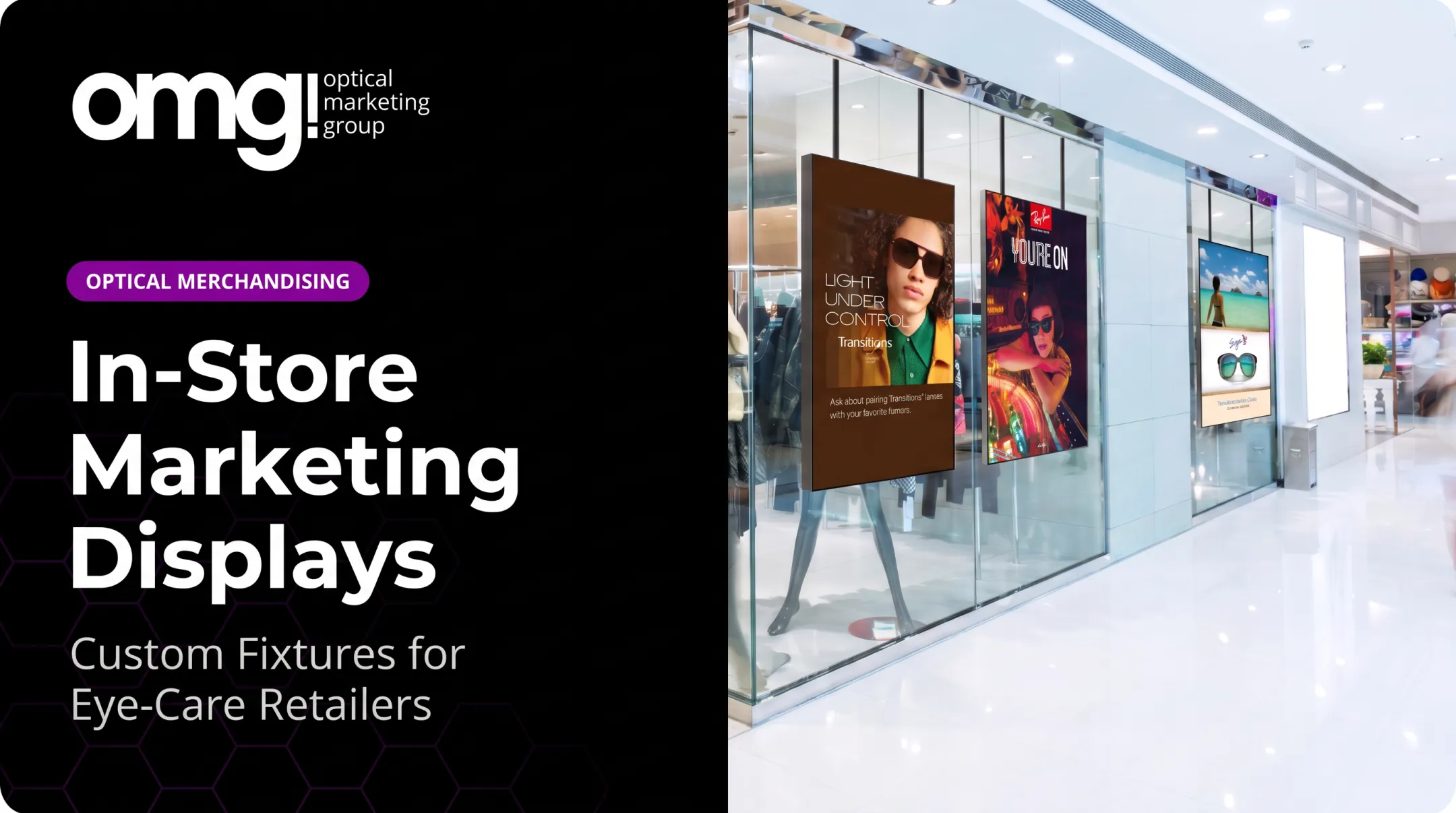
OMG!'s digital signage lineup shows how this works in practice:
- 10-inch Small Retail Ready Tablet for walking patients through lens options on the floor
- 15-inch Interactive Retail Screen for independent frame and lens brand exploration at the display
- 43-inch 4K touch display for frame storytelling and demonstrations near the entrance
OMG!'s Contentlinq offering pairs that hardware with a managed content subscription, so practices aren't left building playlists themselves. A screen only earns its place when content, hardware, and daily workflow are planned together; otherwise it becomes furniture.
Trend 3: Discovery-Driven Signage and Brand Storytelling
Signage that only shouts "SALE" wastes a chance to educate. Good signage helps a shopper understand what makes one frame collection different from another, and why that matters for their lifestyle.
Optical applications worth prioritizing:
- Frame-category navigation (sport, blue-light, designer, kids)
- Lens-benefit storytelling near the dispensing table
- Independent or designer-brand narratives that justify price points
- Lifestyle groupings that naturally open multiple-pair conversations
That same Mood Media research found 42% of shoppers pay attention to retailer video or audio messages in-store, and 37% say they've purchased based on them. It's a combined measure of video and audio, not signage alone, but it confirms that well-placed messaging shapes decisions before a staff member even says a word.
Internally, OMG! frames this as "New Rule #3": gender, vendor, and lifestyle signage helps patients self-navigate and opens the door to multiple-pair sales and higher satisfaction. Clear wayfinding isn't decoration. It's a sales tool.
Trend 4: Data-Informed Personalization and Responsible Technology
Personalization in 2026 means using what you already know, consented purchase history, appointment context, loyalty data, and staff observations, to make better recommendations. It does not mean tracking patients without their knowledge.
Useful applications include:
- AI-assisted content planning for seasonal signage rotations
- Product recommendations based on prior lens purchases
- Connected journeys that link an online appointment to an in-store greeting
More than a third of Gen Z shoppers already prefer personalized marketing inside physical stores, according to Deloitte Digital's 2024 report. That's notable because this is a digitally native generation telling retailers they still want human-scale attention in person.
Guardrails matter here. Health-related data carries HIPAA restrictions on marketing use, and the FTC has warned against misleading claims about biometric data collection. Treat any customer-facing AI tool with transparency and human oversight, and verify specific compliance questions with legal counsel before rolling out new technology.
Trend 5: Modular, Testable, and More Sustainable Merchandising
Full remodels are expensive and disruptive. Modular fixtures and refreshable graphics let practices update their look in smaller, testable increments.
This looks like:
- Swapping graphics panels for seasonal campaigns without replacing the display frame
- Running a signage or layout change in one location before a multi-site rollout
- Comparing baseline sales to post-refresh performance before committing further
Manufacturers like Frank Mayer note that standardized modular components let a broken element get replaced without discarding the whole fixture, extending its usable life. That's a manufacturing efficiency, not an independently verified cost-savings figure, so be cautious about overstating it.
The same caution applies to sustainability claims. The FTC's Green Guides warn against vague "eco-friendly" labeling; any environmental claim should name a specific, substantiated benefit rather than a general promise.
OMG!'s Practice Refresh service, priced at $995 and typically delivered in 5–10 business days, is one way to test a smaller change before a full buildout, with the fee credited toward implementation if the client proceeds.
What's Driving These In-Store Marketing Trends
Shoppers now expect convenience and consistency whether they're online or in your dispensary. Optical practices feel this pressure while also balancing patient care obligations that general retailers don't have.
Technology Advances and Innovation
Cloud-based signage management, like Samsung's VXT platform, now lets retailers update screens remotely and even generate content from text prompts. Computer vision tools can analyze shopper paths using existing cameras.
These capabilities are real, but adoption skews toward large retailers. An NRF survey on retail AI found 70% of respondents represented companies above $1 billion in revenue. Independent practices are more likely to access similar benefits through managed services like Contentlinq rather than building systems in-house.
Market Demand and Customer Expectations
Shoppers increasingly want help navigating physical stores digitally. Mood Media's research found:
- 75% are interested in QR codes for product information
- 71% want real-time recommendations
- 73% want mobile-assisted navigation

For optical, that translates directly: a QR code next to a frame display that explains lens coatings does real work.
Cost Pressures and Efficiency Needs
Clearer wayfinding and modular displays reduce wasted staff time explaining where things are. OMG!'s Patient Experience Assessment, a 9-question scored review of wayfinding, signage, and digital touchpoints, gives practices a structured way to spot inefficiencies before spending on a redesign.
Regulatory, Privacy, and Accessibility Influences
Several US frameworks touch optical in-store marketing:
- HIPAA generally requires authorization before using protected health information for marketing
- FTC guidance warns against misleading biometric data claims and unsubstantiated environmental claims
- ADA standards require accessible service counters and queue paths
- California's CCPA, effective January 1, 2026, sets offline notice requirements for covered businesses collecting data in physical locations
None of this is legal advice. Verify specifics with counsel before implementing new data collection or signage technology.
Competitive Dynamics
Independent practices, optical chains, and online eyewear sellers are all competing for the same patient dollar. The Vision Council's research found online purchasers more likely to recommend their retailer than in-store purchasers did. Physical presence alone doesn't guarantee loyalty. Design and experience still have to earn it.
How These Trends Are Impacting Optical and Eyecare Retail
These trends translate into concrete changes on the floor. The dispensary now has to support confidence, efficient movement, and measurable outcomes simultaneously.
Operational Impact
Layout, sightlines, and signage hierarchy directly affect how patients move through your space. A confusing handoff between exam and optical areas creates friction exactly when a patient is ready to buy.
Map the patient journey to find high-value touchpoints:
- Arrival and check-in
- Waiting and pre-exam browsing
- Frame selection
- Lens discussion at dispensing
- Checkout
- Pickup and follow-up
Each step is a chance to either build momentum toward a sale or lose it.
Business Impact
In-store marketing should connect to KPIs you can actually track:
| KPI | What it measures |
|---|---|
| Optical capture rate | % of exam patients who purchase eyewear |
| Frame conversion | % of browsers who buy frames |
| Average transaction value | Dollar amount per sale |
| Multiple-pair sales | % of patients buying more than one pair |
| Repeat visits | Returning-patient frequency |
Compare performance before and after a signage change or display refresh. Factor in seasonality, staffing changes, and ongoing promotions, or you'll misread the results.
OMG!'s Patient Experience Assessment, online Project Planner, and six-phase design-to-delivery process help practices evaluate their current environment and plan changes methodically. None of these require a full rebuild; many practices start with a targeted refresh instead.
Workforce Impact
New signage or digital tools are useless if staff don't know how to use them in conversation. Training should cover:
- Visual merchandising awareness
- Digital content stewardship (updating screens, not just displaying them)
- Privacy-conscious personalization
- Accessibility awareness for patients with visual or mobility needs
OMG!'s Retail Consulting package, a two-day on-site session with eight weekly follow-ups, is built around this gap: giving staff the skills to treat the environment as a sales aid, not a backdrop.

Future Signals for In-Store Marketing
These 2026 trends will keep evolving as technology, privacy norms, and retail formats shift. Watch for:
- Connected content systems linking online appointment data to in-store greetings
- Real-time inventory displays showing what's actually in stock
- Computer vision and anonymized traffic analysis, though mainstream optical adoption isn't established yet
- Generative AI content tools, already available in platforms like Samsung's VXT, for faster signage variations
- Virtual try-on tools, still more common in general retail pilots than documented optical deployments
Over the next one to three years, most practices will likely fall into one of three paths:
- Low-tech refresh: improved layout and signage without new hardware
- Digitally enabled dispensary: managed screens and QR content through a service like Contentlinq
- Multi-location program: standardized brand guidelines tested through measurable pilots before a full rollout
None of these paths is inherently better. The right one depends on your practice size, budget, and how much staff bandwidth you have to manage new tools.
Conclusion
In-store marketing in 2026 is becoming more intentional and more measurable than before. The practices that win won't necessarily have the most screens. They'll have the clearest patient journey and a disciplined way to track what actually works.
Start with a focused foundation:
- Map your patient journey
- Choose technology that supports staff rather than replacing them
- Measure results against clear goals before expanding
Strategic design and merchandising can make every touchpoint in the eyecare experience feel more welcoming, while still driving the retail performance your practice needs.
Frequently Asked Questions
What are some effective in-store marketing strategies?
Discovery-driven signage, clear merchandising zones by lifestyle or brand, digital lens education, and QR-enabled content all work well in optical settings. Pair these with staff training and consistent measurement of capture rate and multiple-pair sales.
What is in-store marketing?
In-store marketing includes any promotional, informational, or merchandising activity that influences customers inside a physical location. In an optical dispensary, this spans everything from frame display layout to digital signage explaining lens options.
What are the 3 C's in retail?
Definitions vary by source. One common framework, from strategist Kenichi Ohmae, defines it as corporation (or company), customers, and competitors. Verify which version applies before using it in your own planning.
What is Gen Z in marketing?
Gen Z refers to consumers generally born after 1996. This cohort values mobile-friendly information, authentic brand storytelling, and accessible experiences that blend smoothly between digital research and in-person visits.
What is the 40-40-20 rule in marketing?
This heuristic, often attributed to direct-mail pioneer Ed Mayer, suggests 40% of campaign success depends on audience targeting, 40% on the offer, and 20% on creative execution. Treat it as a planning guide, not a guaranteed formula, and validate it against your own campaign data.