
Introduction
Patients form an opinion about your practice before a single staff member says hello. Layout, lighting, signage, and how frames are displayed all send a message, whether you've planned it or not.
Many practices struggle with this. According to OMG!'s internal practice-branding research, fewer than 5% of optical retailers have proper signage throughout their facility.
That gap leaves patients unsure where to find specific brands or product categories, and the confusion costs sales.
Visual merchandising services bring design and retail strategy together to fix this. They make eyewear easier to discover while keeping the patient journey smooth, from check-in to final frame selection.
This article covers what these services actually include, the real benefits (and limits) they offer, how the process typically unfolds, and what to look for in a qualified optical merchandising partner.
Key Takeaways
- Visual merchandising uses space, lighting, displays, and signage to guide patient behavior, not just decorate a room
- Optical merchandising must balance clinical credibility with retail discovery and easy browsing
- Services typically span space planning, fixtures, signage, graphics, production, and installation
- A qualified partner understands optical workflow, patient flow, and how to measure results after launch
What Visual Merchandising Means for Eyecare Practices
Visual merchandising is the planned presentation of products and the space around them, designed to catch attention, communicate value, and make navigation effortless. Every layout decision, fixture choice, and sign should serve a purpose.
Optical merchandising carries extra weight compared to general retail. A clothing boutique doesn't need to manage patient privacy during a vision screening or transition someone smoothly from an exam chair to a frame wall. An optical space does both at once.
It has to balance several things simultaneously:
- Clinical credibility and trust
- Privacy during testing and consultations
- Easy frame browsing and product discovery
- Accessibility for patients with varying vision needs
- A retail atmosphere that doesn't feel like a waiting room
Strategic merchandising differs from simple decorating in one key way: intent. A wall of frames isn't automatically a display.
As Patricia Bobilin wrote in Review of Optometric Business, displays should sell frames, not just store them. Each category needs appropriate branding, holders, and shelving.
When Practices Typically Need This
Most projects start around a specific trigger:
- Opening a new office or relocating
- Expanding the optical footprint
- Refreshing a dated dispensary
- Rolling out a design standard across multiple locations
- Launching a branded display program for an eyewear or lens line
What Visual Merchandising Services Include
A professional visual merchandising service starts with an assessment of the practice's brand, floor plan, target patient, and current pain points. From there, the work breaks into several distinct phases.
Space planning and traffic flow comes first. This means mapping how patients move from reception or exam areas into the optical space without bottlenecks. OMG!'s discovery phase, for example, develops a space and fixture plan around existing structural elements before anything gets built.
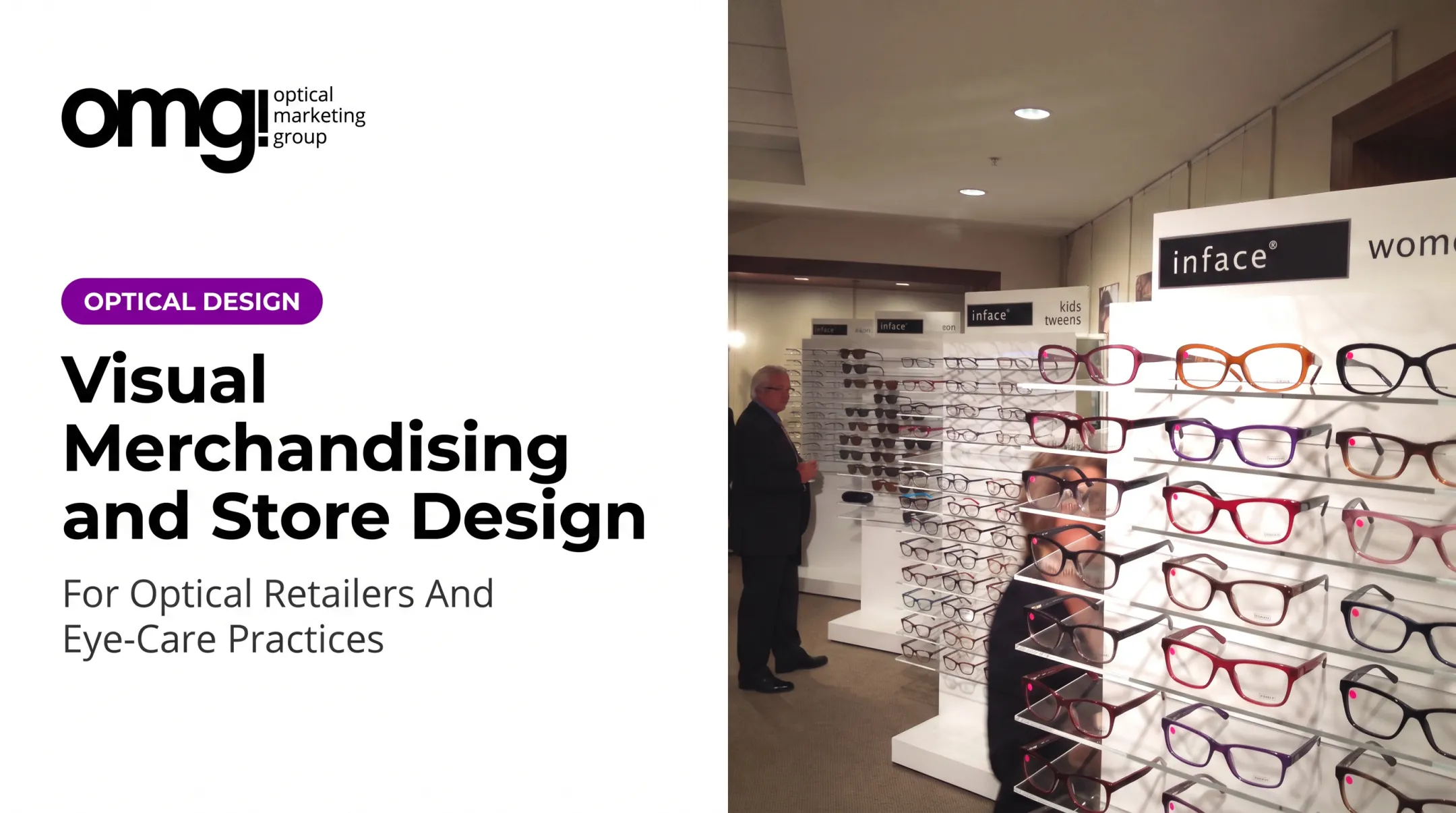
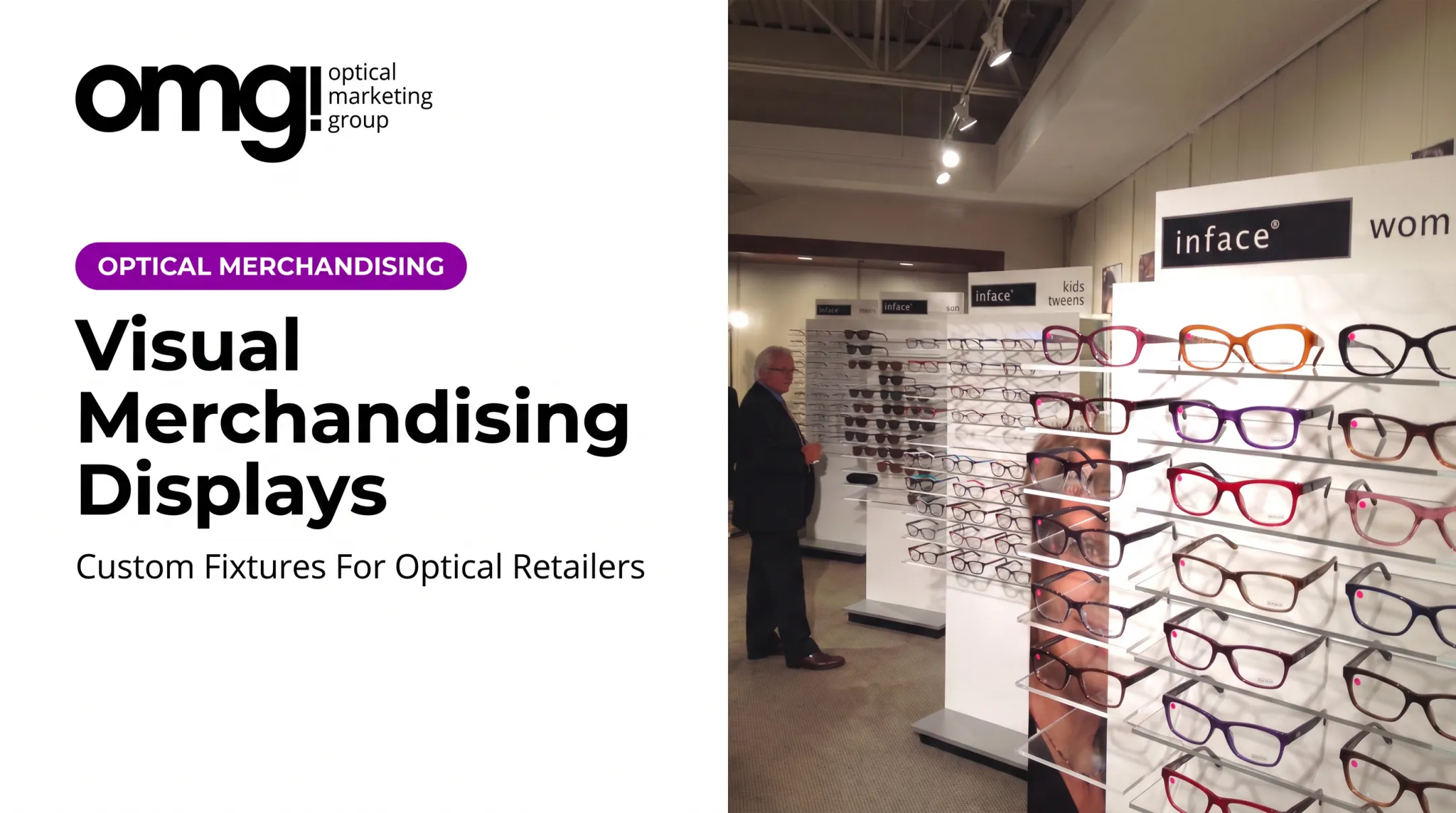
Frame presentation and product grouping follows. Collections get organized by brand, lifestyle, material, or price tier, whatever makes sense for how patients actually shop. This is where open shelving and risers often replace traditional frame boards, since accessible displays tend to invite more browsing than a wall of identical slots.
Fixtures, Signage, and Digital Tools
The physical and visual elements that bring the plan to life include:
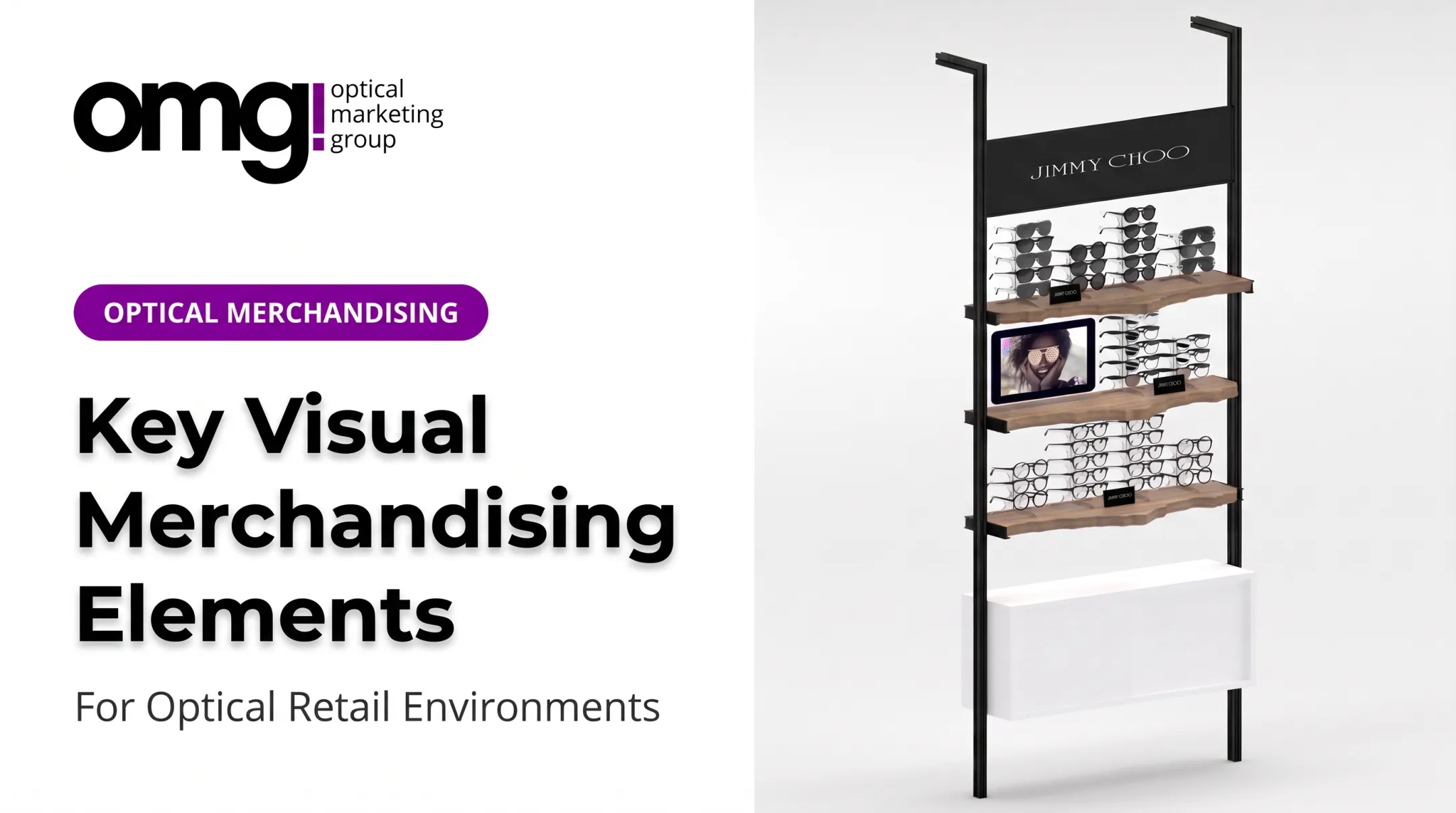
- Custom fixtures, shelving, and point-of-purchase displays
- Mirrors and counters positioned for natural try-on moments
- Branded graphics and wayfinding signage
- Window and exterior presentation
- Digital displays for lens education or brand storytelling
Execution support ties it together: design concepts, production drawings, manufacturing coordination, installation, and adjustments after the install team leaves. A service that only designs but doesn't help manufacture or install leaves practices managing three vendors instead of one.
The Business Benefits of Optical Visual Merchandising
Better layout changes how patients behave, not just how a room looks. When browsing starts earlier, usually before the exam even finishes, patients arrive at the dispensary with less friction.
A 2022 case documented in ROB's renovation case study illustrates this. Bellaire Family Eye Care in Houston expanded its optical, made it visible from the entrance, and moved sunwear from locked cabinets into an open tower.
The practice reported a 31% increase in optical revenue alongside a 40% larger optical footprint. Several changes landed at once, so layout alone does not explain the full gain.

What to Actually Track
Instead of chasing one magic metric, watch a small set of indicators before and after a merchandising change:
- Optical capture rate: the share of patients with a prescription who buy eyewear at your practice
- Frame-category performance: which groupings or brands move faster post-redesign
- Multiple-pair sales: tracked over a defined window, not just isolated transactions
- Patient questions and browsing behavior: staff can note shifts qualitatively
- Staff feedback: frontline opticians often notice friction points first
One practice owner, Alex Martin of Martin Eye Associates, reported a 70% capture rate in a case described by ROB's capture-rate article, built on a mix of familiar and lesser-known frame brands alongside clear price segmentation. That's a strong result from one practice, not a universal benchmark every clinic should expect to hit.
Consistent visual elements, from exterior signage to exam-to-optical transitions, also reinforce brand recognition across every touchpoint. Patients remember a cohesive experience even when they can't articulate why.
How the Visual Merchandising Process Works
A well-run engagement moves through distinct stages, each building on the last.
- Discovery: Review goals, patient experience, brand positioning, product mix, staff workflow, and the existing floor plan. Flag operational constraints like lease restrictions or structural walls at this stage too.
- Concept and planning: Draft space-planning recommendations, material direction, and display strategy with the practice team early, before anyone commits to final designs.
- Design development: Document fixture specifications, graphics, lighting plans, and digital display requirements. OMG!'s process includes pre-construction drawings covering electrical and reflected-ceiling plans for illuminated displays.
- Review and production: Secure approvals, prototype where needed, and manufacture before installation to cut surprise changes mid-project.
- Installation and rollout: Handle delivery, staff orientation on new display standards, and final adjustments to close out the build.
- Measurement and refinement: Establish a baseline, pick a handful of relevant indicators, and compare results over time.

This last stage is the one practices skip most often. Without a baseline capture rate or sales figure recorded before the redesign, it's nearly impossible to credit any after-the-fact improvement to the new space with confidence.
Choosing a Visual Merchandising Partner and Avoiding Common Mistakes
Not every design firm understands optical. General retail experience doesn't automatically translate to clinical-retail transitions, patient privacy needs, or how an optician actually works a dispensary floor.
Questions worth asking a prospective partner:
- How do you approach frame displays and patient flow specifically in optical settings?
- Can I see a portfolio with variety across new builds, refreshes, and multi-location rollouts?
- Do you handle design, fixtures, graphics, and installation, or do I need separate vendors?
- What does your approval process look like, and who's my point of contact throughout?
- How will we measure whether the redesign worked?
Mistakes That Undermine Good Intentions
Even well-funded projects go wrong in predictable ways:
- Overcrowded displays that overwhelm rather than guide
- Poor or generic office lighting instead of jewelry-store-quality fixtures
- Unclear wayfinding, forcing patients to ask staff for directions
- Inconsistent branding between exterior signage and interior displays
- Designs that prioritize looks over actual staff workflow
Before signing anything, get clarity on deliverables, timeline assumptions, installation responsibilities, and revision policies. A vague scope document almost always leads to a frustrating project.
Why Work With an Optical Visual Merchandising Specialist?
OMG! Optical Marketing Group is a Southern California-based studio that has spent more than two decades focused specifically on optical sales and merchandising, not general retail design borrowed and applied to eyecare. Founder Bill Gerber started in optical sales before founding a display company in 1998, then launched OMG! in 2012 to bring design and merchandising together under one roof.

That multidisciplinary model matters in practice. One project plan covers interior, architectural, graphic, UX, production, and installation work instead of handing tasks between disconnected vendors. The six-phase process, from discovery through installation, keeps timelines predictable and cuts mid-project surprises.
OMG! also offers a Patient Experience Assessment that scores a practice across nine areas on a 1-to-5 scale, including:
- Wayfinding
- Lighting quality
- Shelving
- Brand storytelling
It gives practices a clear read on where the current space falls short. An online Project Planner maps scope and budget before any commitment.
Engagements scale to the work you need:
- Full interior build
- Targeted dispensary refresh
- Branded point-of-purchase displays for an eyewear line
- Consistent fixture packages across multiple locations
If your optical space isn't doing its job, that's worth a conversation. Reach out to OMG! to discuss your space, your patients, and where a redesign might move the needle.
Frequently Asked Questions
What does visual merchandising do?
It uses layout, lighting, displays, signage, and product grouping to guide patient attention and make navigation easier. The goal is shaping the experience so patients browse comfortably and find what they need without asking staff.
What are the 7 key elements of visual merchandising?
For an optical practice, these typically include store layout, frame placement, lighting, color and material finishes, signage, display fixtures, and digital or interactive elements like tablets. Each should support patient flow and discovery, not just aesthetics.
What services are included in visual merchandising?
Most services cover an initial assessment, space planning, fixture and display design, signage and graphics, lighting and digital display planning, production coordination, installation, and periodic refreshes as product lines change.
How can visual merchandising improve an optical practice?
A well-designed space can support earlier browsing, smoother patient flow, and clearer brand presentation. Practices often track capture rate and multiple-pair sales afterward, though results vary by practice and aren't guaranteed by design alone.
How do I choose a visual merchandising service provider?
Look for direct optical industry experience, not just general retail design work. Review their portfolio, confirm they handle design through installation in-house, and ask how they'll help you measure results after launch.