
Introduction
Walk into most optical dispensaries and you'll notice the same problem: frames that are technically available but practically invisible. Patients wander past entire collections because nothing tells them where to look or why it matters.
That's a real cost. Nearly 90% of purchase decisions happen inside the store, not before it, according to OMG's internal client research.
Yet less than 5% of optical retailers have proper signage throughout their dispensary, leaving patients to guess which brands, lens options, or promotions actually apply to them.
Point-of-purchase (POP) advertising fixes this gap. It gets dismissed as "just displays and signs," but its real value shows up in everyday outcomes: easier product discovery, more confident frame selection, and a dispensary that feels curated instead of cluttered.
This article defines POP advertising, breaks down its advantages in optical settings, covers what happens when it's ignored, and explains how to measure and improve it.
Key Takeaways
- POP shapes how patients discover and compare products; POS is where the transaction closes.
- Optical POP makes frames, lenses, and promotions easier to notice without cluttering the dispensary.
- Strong programs combine smart placement, concise messaging, cohesive design, accessible products, and trained staff.
- Track optical capture, frame sales, multiple-pair sales, and average transaction value.
What Is Point-of-Purchase Advertising?
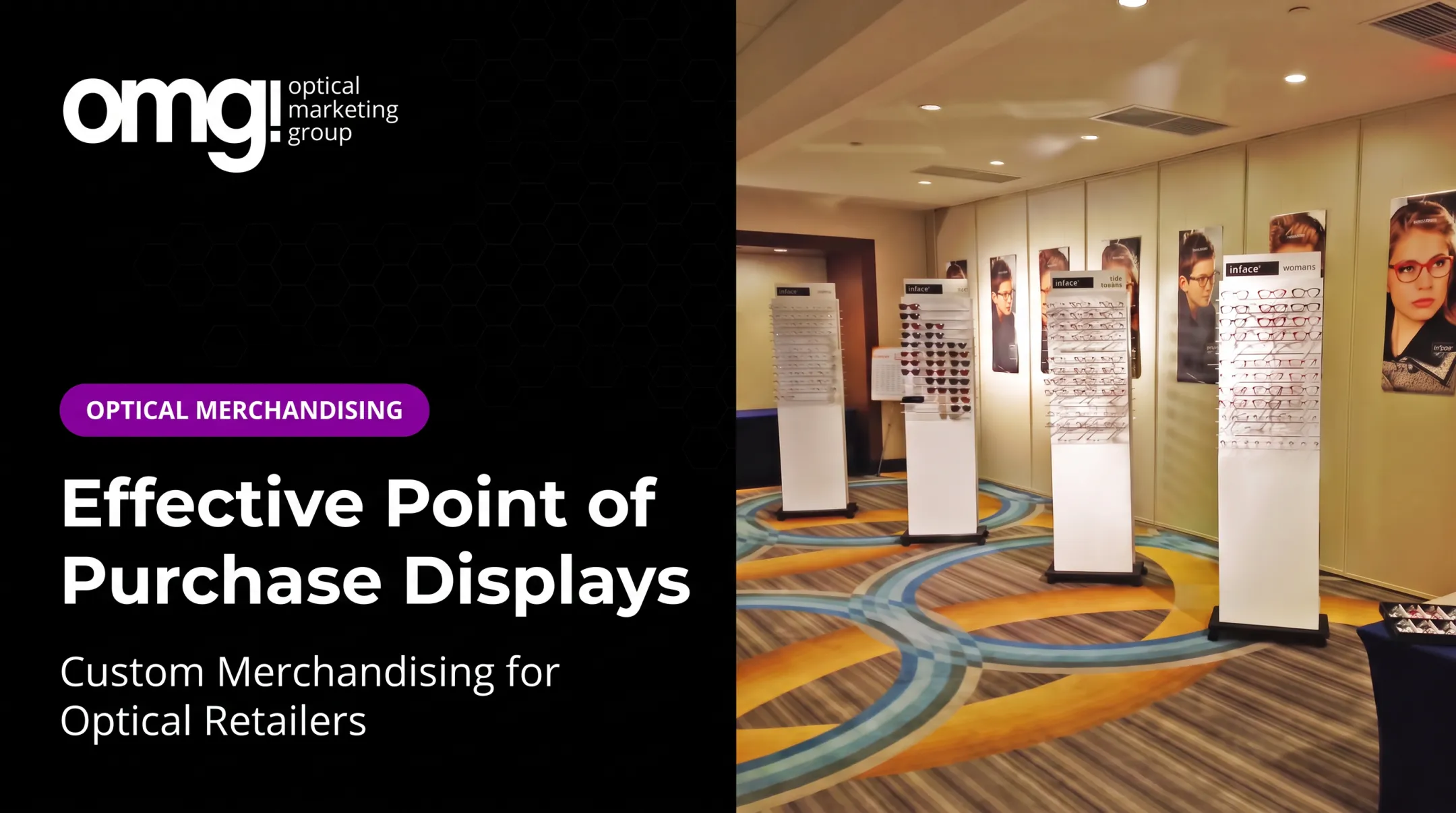
Point-of-purchase advertising covers displays, signage, fixtures, digital content, demonstrations, packaging, and promotional messages placed exactly where customers make product decisions. In an optical dispensary, that means everything from a window display to a lens-education graphic posted near the exam lane.
It's easy to confuse POP with point of sale (POS), but they describe different moments. POP spans the entire browsing and decision-making journey: the window, the frame wall, the counter display. POS is narrower. It's simply the location where payment gets processed, one piece within the broader POP environment rather than a separate category.
Where POP Shows Up in a Dispensary
In practice, optical POP typically includes:
- Window displays showcasing seasonal collections or sunglasses
- Frame walls or open shelving organized by brand, lifestyle, or price point
- Counter displays for accessories, cases, or cleaning kits near checkout
- Lens-education graphics explaining progressive, blue-light, or photochromic options
- Mirrors positioned for easy self-viewing during frame selection
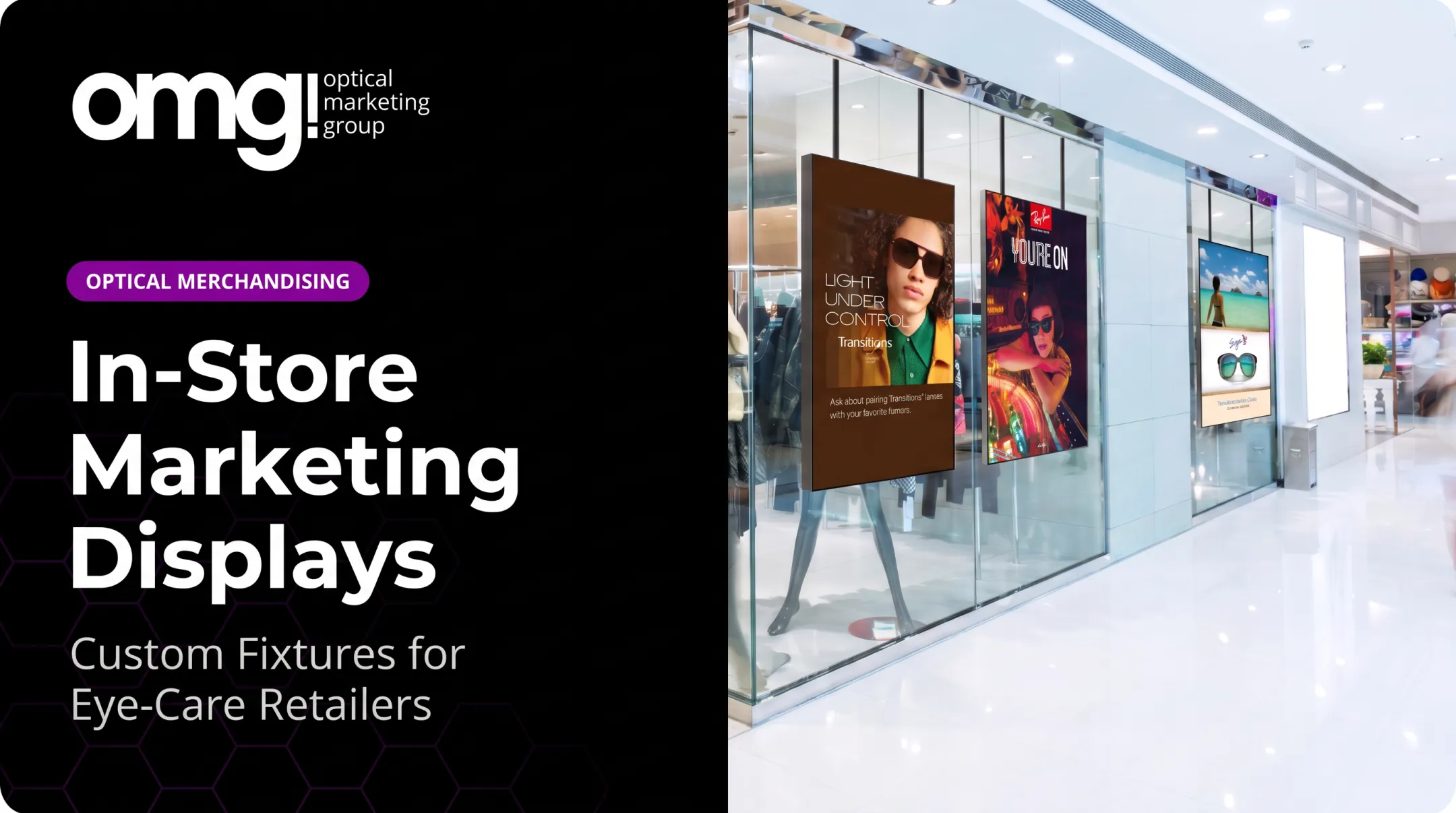
- Digital screens running branded content, promotions, or interactive lens demos
None of this replaces professional recommendations or attentive staff. POP works best as scaffolding. It points patients toward the right conversation, then gets out of the way. A practice with great product and weak service won't fix either problem with a sign.
At OMG! Optical Marketing Group, this spans custom frame displays, branded signage, and digital screens through Contentlinq, treating POP as one coordinated system rather than scattered signs ordered as an afterthought.
Key Advantages of Point-of-Purchase Advertising
The strongest POP advantages are operational and measurable:
- Better product visibility
- Clearer product communication
- Smoother in-store browsing
- More relevant add-on purchase opportunities
Advantage 1: Improve Product Visibility and Discovery
Strategic placement is what separates a boutique dispensary from a warehouse. Lighting, sightlines, and branded fixtures determine whether patients notice your sunglass wall or walk right past it.
Optical merchandising consultant Linda Conlin notes that shoppers browse horizontally first, and that merchandise sells best between 4 and 5 feet off the floor, the natural eye-level zone, according to 2020 Mag's guidance. Placement should follow patient flow and dwell time, not just fill empty wall space.
POPAI's 2021 specialty-retail research found shoppers respond best to minimal, uncluttered displays with large imagery and prominent text. Over half felt retailers used window space well; nearly a third said stores could still improve.

Why it matters: better discovery shows up in frame category performance, optical capture, and how many products a patient actually considers during a visit.
When it matters most: new collection launches, underperforming categories, or layouts where patients bypass entire sections of the dispensary.
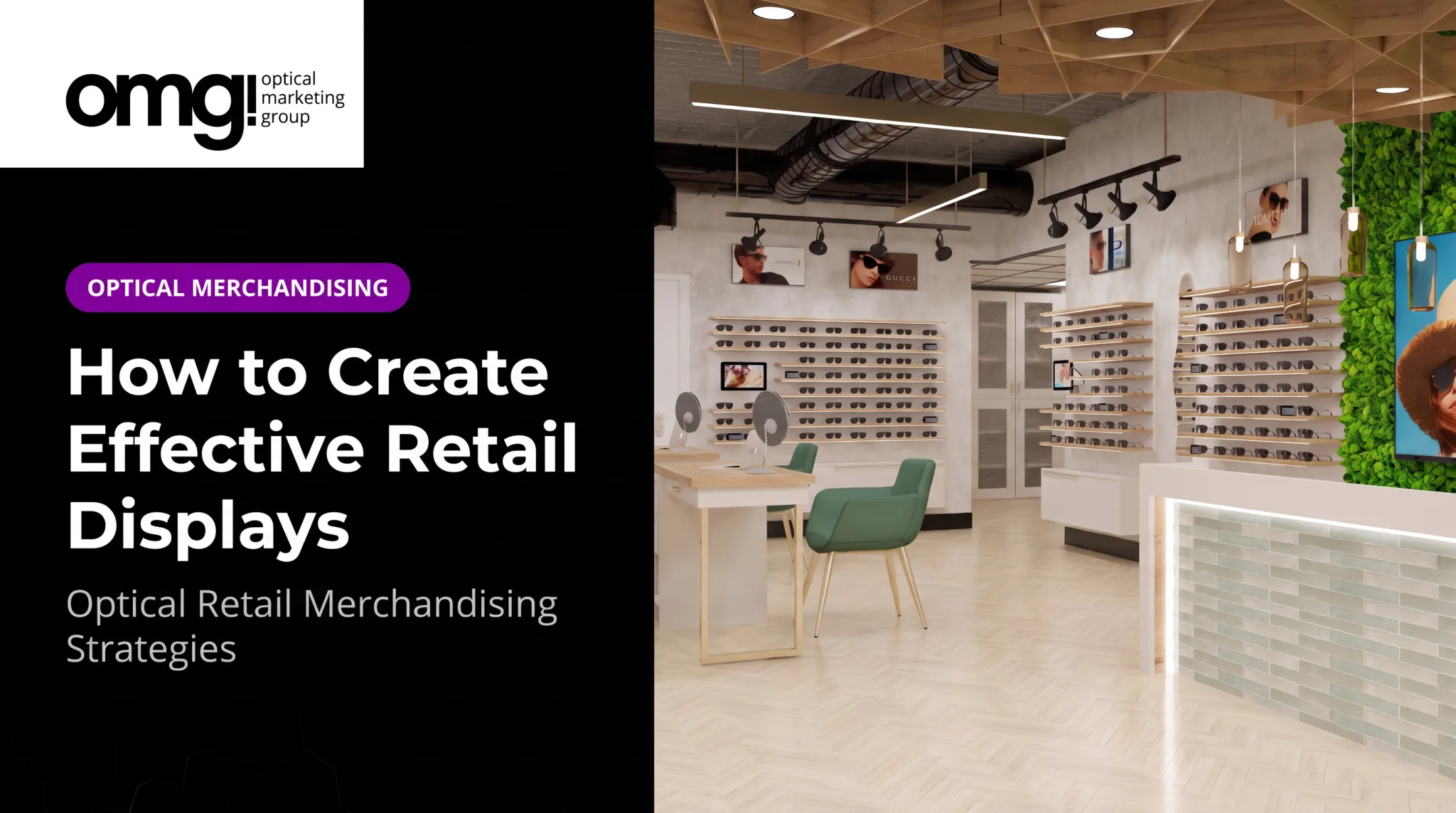
OMG!'s modular systems, including Del Mar, Cedros, and Palomar, use adjustable shelving and integrated LED lighting to solve this, replacing dense frame boards with featured, well-lit product zones.
Advantage 2: Educate Patients and Support Confident Decisions
Premium lenses, specialty treatments, and children's eyewear share one challenge: patients don't understand the value until someone explains it. Concise signage can do the first pass of that explanation before a conversation even starts.
Good retail signage practice uses the minimum words necessary and clear, legible fonts; cluttered copy discourages reading rather than informing it. The goal is to prompt a question, not answer everything on the wall.
Why it matters: clearer education reduces decision friction and sets up more productive staff conversations. Track:
- Questions asked at the dispensing table
- Lens-option selection rates
- Demonstration requests
When it matters most: new lens technologies, progressive or photochromic upgrades, and specialty frames that need context before patients see their value.
OMG!'s Interactive Lens Selector and Featured Brands Patient Education signage simplify technical comparisons into a format patients can digest in seconds, then hand the conversation to the optician.
Advantage 3: Strengthen Brand Experience and Sales Performance
Consistent colors, typography, lighting, and messaging turn a clinical dispensary into a curated retail space. That consistency supports brand storytelling and guides patients from initial browsing through frame selection, lens discussion, and purchase.
Consider Bellaire Family Eye Care in Houston. The practice renovated its optical, making it 40% larger and moving reception adjacent to it so products became easier to see and reach.
It reported a 31% increase in overall optical revenue afterward, according to Review of Optometric Business. Layout, access, and presentation all changed together, so the result reflects the full redesign rather than signage alone.
Why it matters: a cohesive environment supports brand recognition, optical capture, multiple-pair sales, and average transaction value.
When it matters most: dispensary refreshes, relocations, new office openings, or standardizing design across multiple locations.
Picture a seasonal sunglass campaign: window graphics featuring key brands, a matching counter display, a digital screen looping lifestyle content, and staff briefed on the same three talking points. Each touchpoint reinforces the others instead of competing for attention. That kind of coordinated rollout is what OMG! handles for independent practices and multi-location chains alike.
What Happens When Point-of-Purchase Advertising Is Missing or Ignored
Products that are technically in stock can still be invisible if patients can't find them, understand them, or connect them to your brand. That's the real cost of skipping POP: not a dramatic failure, just a slow leak of missed opportunities.
Common consequences include:
- Inconsistent presentation that makes the practice feel disorganized
- Unused display space that could highlight a featured collection
- Patient confusion about which frames fit which price point or lifestyle
- Missed add-on opportunities for cases, lens upgrades, or accessories
- Overreliance on staff to verbally explain things a sign could handle
Operational risks compound the problem. Cluttered walkways, inaccessible frames, damaged or outdated signage, and promotions for products that are already sold out all erode patient trust.
Outdated fixtures create the same drag. Bill Gerber's New Rules of Optical Retailing flags traditional frame boards, a display model dating back to the 1950s and 1960s, as an antiquated concept that buries product instead of featuring it.
A reality check: POP can't fix poor inventory, weak service, bad pricing, or an inefficient layout. It's one part of a complete optical retail strategy, not a substitute for the fundamentals. A beautifully signed dispensary with empty shelves or untrained staff will still underperform.
How to Get the Most Value from Point-of-Purchase Advertising
POP works best when it's planned around a specific objective, built into the physical space, and reviewed regularly, not installed once and forgotten.
Set One Clear Objective and Audience
Goals differ by project. A new frame launch calls for different messaging than premium lens education, a multiple-pair promotion, or a full dispensary refresh. Before choosing a display format or producing artwork, define:
- Who the campaign targets
- The core message, in one sentence
- The action you want patients to take
- How long the campaign runs
Design for the Environment and Patient Journey
Audit entry sightlines, waiting areas, frame walls, mirrors, consultation zones, and checkout before placing any material. Lighting, accessibility, and traffic flow matter as much as the message itself.
Keep copy concise, establish a clear visual hierarchy, and make sure every featured product is actually reachable. Signage should match your clinical setting as much as your brand.
Coordinate Physical and Digital Touchpoints
Printed signage, custom fixtures, window displays, and digital screens should reinforce one message, not duplicate or compete with each other. A seasonal lens promotion works best when the window graphic, the counter card, and the screen content all say the same thing in different formats.
OMG! Optical Marketing Group supports this kind of integrated program: custom displays, branded signage, fixtures, graphics, and Contentlinq digital screens delivered through one design-to-delivery process, instead of ordering signage, fixtures, and screens from three separate vendors.
Prepare the Team and Maintain Execution
Brief staff on what each display is for, what questions it should prompt, and when to step in with a professional recommendation. A sign nobody on the floor understands won't do its job.
Build a maintenance routine covering:
- Stock levels behind featured displays
- Damaged or outdated materials
- Lighting and screen content
- Cleanliness and display compliance across locations
Measure, Test, and Refine
Compare before-and-after or test-versus-control results on frame sales, optical capture, multiple-pair sales, average transaction value, and campaign redemptions. OMG's Patient Experience Assessment scores a practice across nine merchandising-related categories, out of 45 points total, giving a useful baseline before and after a refresh.
Read results alongside inventory changes, staffing shifts, pricing, and seasonality. Don't credit POP alone for a swing that had multiple causes. Use what you learn to adjust placement, message, format, or featured products, then test again.

Conclusion
Point-of-purchase advertising earns its keep at the exact moment patients are browsing, comparing, and deciding. Done well, it gives a practice control over that moment instead of leaving it to chance.
The strongest optical POP programs share the same traits:
- Thoughtful placement
- Accessible products
- Concise education
- Consistent branding
- Trained staff
- Regular measurement
Skip any one of those, and the rest can only do so much.
Treat POP as an ongoing merchandising discipline, not a one-time sign order or display installation. Dispensaries change, collections rotate, and patient expectations shift. Whether you're refreshing a dated dispensary or standardizing design across several locations, OMG! Optical Marketing Group builds POP programs from custom fixtures to digital signage. Those programs are designed to evolve with the practice instead of sitting still.
Frequently Asked Questions
What does point of purchase (POP) mean in marketing?
Point of purchase refers to the place and moment where a customer considers or decides to buy, such as a window display, frame wall, or counter sign. Point of sale (POS) specifically means where the transaction is completed, like the checkout counter in a dispensary.
What are the main types of advertising?
Major categories include print, digital, broadcast, outdoor, social, direct mail, and point-of-purchase advertising. POP is particularly useful because it reaches customers already browsing your dispensary, not people you're trying to attract from outside.