
That impression shapes everything that follows: whether they browse longer, ask questions, or walk right back out.
Visual merchandising is the strategic presentation of products and retail environments to attract attention, communicate brand value, guide shopping behavior, and support business goals. It's not decoration. It's a deliberate system connecting aesthetics to customer action.
This article breaks down the core principles of visual merchandising, how to apply them practically, and what they mean specifically for optical retail and eyecare practices across the US.
Key Takeaways
- Visual merchandising blends layout, lighting, signage, fixtures, and digital elements into one cohesive customer experience
- Strong merchandising makes products easier to find while reinforcing brand identity from entry to checkout
- Optical practices need a dual approach: clinical trust paired with retail-style frame discovery
- Track real indicators (capture rate, dwell time, conversion) rather than judging by appearance alone
What Is Visual Merchandising in Retail?
Visual merchandising often gets lumped in with "store design" or "decoration." They're not the same thing.
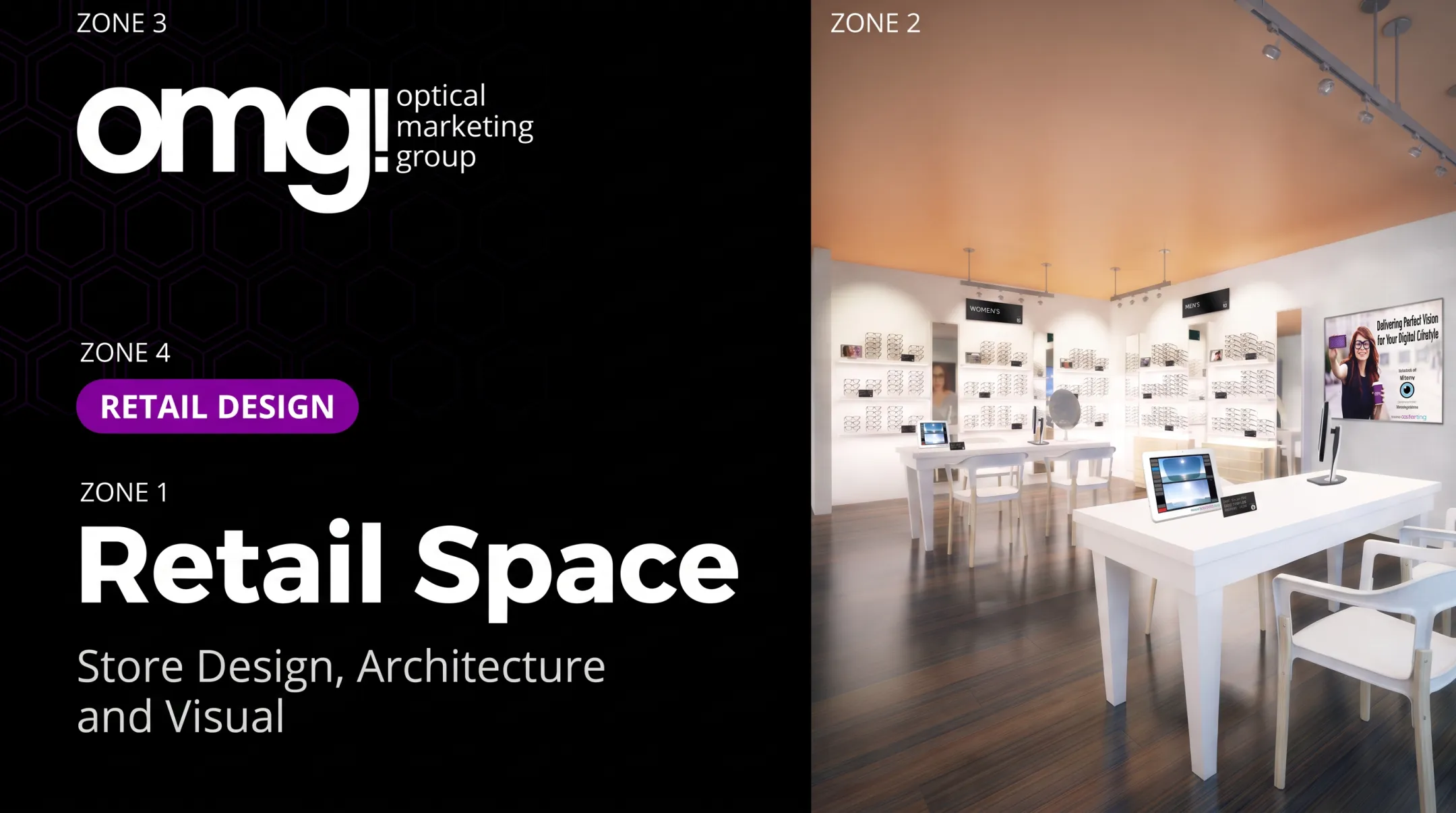
General merchandising decides what products to stock and how to price them. Retail design focuses on the architecture and build-out of a space. Store decoration is purely aesthetic. Visual merchandising sits at the intersection of all three: it connects how a space looks to how customers behave inside it.
A visual merchandiser's job typically includes:
- Assessing the space and traffic patterns
- Planning product placement and groupings
- Coordinating displays, signage, and lighting
- Maintaining brand consistency across touchpoints
- Reviewing what's working and adjusting
Physical and Digital Touchpoints Work Together
Visual merchandising doesn't stop at the front door. It spans storefronts, interior displays, point-of-purchase areas, digital screens, and even social content that previews the in-store experience.
There's no single template that works everywhere. The right approach depends on the retailer's audience, product category, available space, brand position, and the customer journey the business wants to create. A jewelry boutique and a hardware store need entirely different merchandising logic, even though both are "retail."
Why Is Visual Merchandising Important for Retail?
A disorganized store creates friction. A thoughtfully merchandised one removes it. Customers can see what's available, understand pricing and categories, and move through the space without confusion.
That matters more than it might seem. Academic research on store atmospherics has shown that supplemental display lighting produces measurable, statistically significant effects on how long shoppers linger and what they touch, based on an observational study of over 2,000 shoppers across two retail locations.
The effect depends on the display itself: lighting alone isn't magic, but paired with the right presentation, it changes behavior.
What Strategic Displays Actually Accomplish
Good merchandising does several jobs at once:
- Increases product visibility and discovery
- Supports cross-selling through logical groupings
- Makes promotional or educational messages easier to notice
- Reinforces brand recognition through consistent presentation
One US convenience store chain documented this directly. After installing improved shelf and display lighting, the retailer recorded a 2024 lighting case study showing 7.4% higher dollar sales and 4.8% higher unit sales compared to the same period the prior year. That's one bounded example, not an industry-wide guarantee, but it shows the mechanism works.

The Operational Payoff
Clear layouts aren't just about looking good. They also:
- Smooth customer flow, reducing bottlenecks near checkout or consultation areas
- Make staff interactions faster because employees aren't hunting for products either
- Simplify restocking and maintenance
What to measure: Foot traffic, dwell time, conversion rate, average transaction value, multi-item attachment rate, customer feedback, and (for optical practices specifically) capture rate.
The Key Elements of Effective Visual Merchandising
Every effective display system rests on a handful of core elements working together.
Storefront and Entrance
The storefront is the first visual signal of identity. Clear messaging, visibility from the street, and an uncluttered entrance all matter. A common mistake: overlapping graphics and dense signage that make a store look chaotic rather than inviting, especially when viewed from a passing car.
Layout and Traffic Flow
Good layout considers sightlines, a "decompression zone" near the entrance where shoppers adjust to the space, logical product zones, and clear focal points. Browsing areas should connect naturally to checkout or consultation points, not feel disconnected from them.
Product Presentation
Grouping matters more than most retailers realize. Products should be organized by:
- Customer need or use case
- Style, material, or price tier
- Complementary categories (so related items sit near each other)
Varying heights and spacing prevents a wall of inventory from looking flat or overstocked.
Lighting, Color, and Contrast
Lighting does two distinct jobs: it sets atmosphere and helps customers evaluate what they're looking at. Industry guidance recommends a Color Rendering Index (CRI) above 80 for retail environments, according to ASSIST's lighting guide, since poor rendering distorts how products actually appear.

For optical retailers, this is critical. Patients need to see true frame color and lens clarity, not a greenish or yellow-tinted version of it, and without glare bouncing off display glass.
Signage and Visual Storytelling
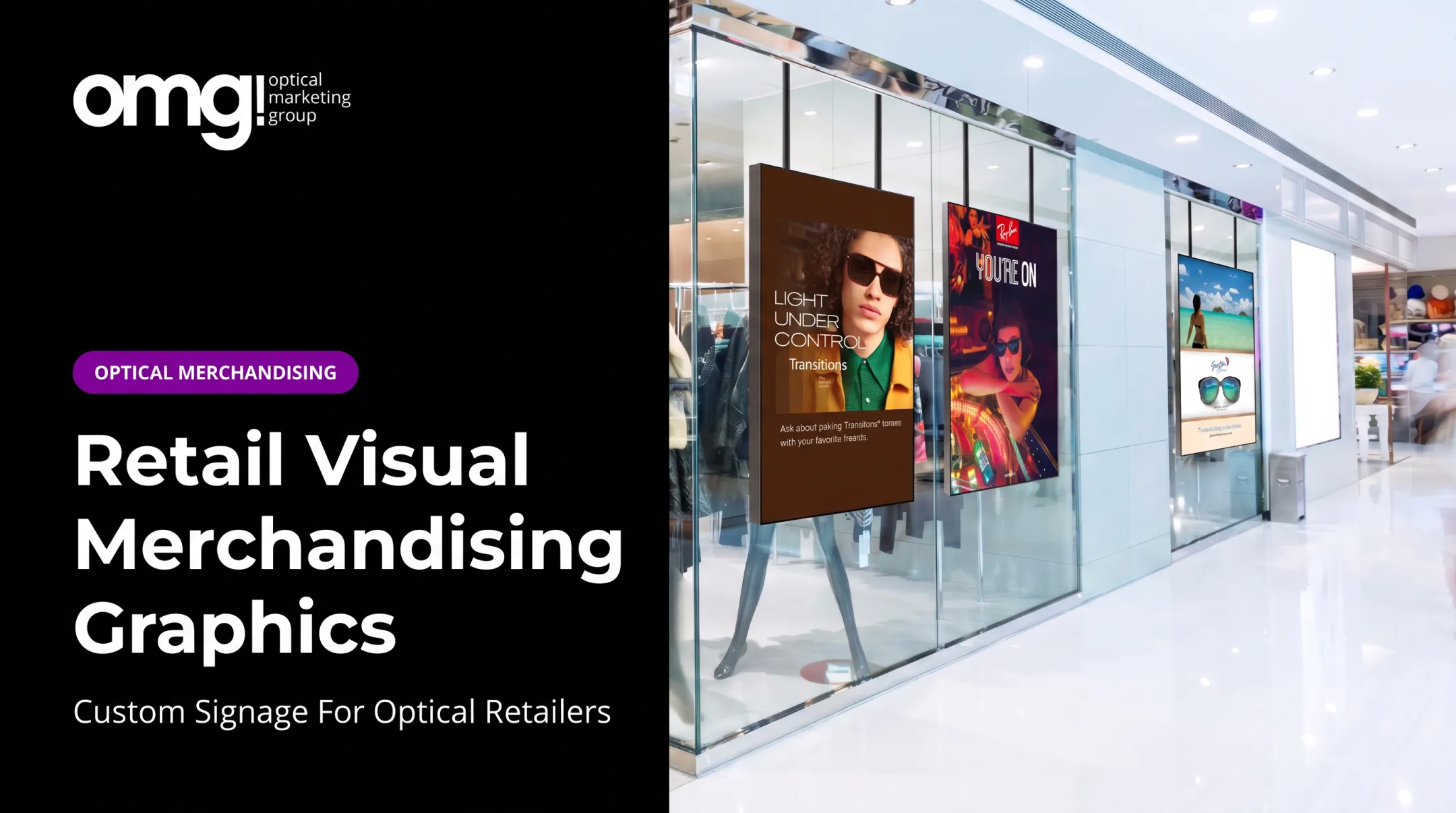
Signage should be concise, educational, and consistent in typography and voice. It needs to do more than label a shelf: it should explain value, guide wayfinding, and reinforce pricing or promotions clearly.
Digital Screens and Interactive Displays
Digital elements can support product education and promotions, but there's a line between useful interaction and distraction. A screen that explains a product feature adds value. A screen that's just noise competing with the merchandise doesn't.
Quick gut-check for any visual element: Does it attract attention, explain value, guide movement, simplify choice, build trust, or prompt action? If it does none of these, reconsider it.
Types of Visual Merchandising in Retail
Different formats serve different moments in the customer journey.
| Type | Primary purpose |
|---|---|
| Storefront/window | Converts passersby into visitors through seasonal storytelling and brand presence |
| Interior displays | Wall bays, shelving, tables, and focal zones organize browsing by category |
| Point-of-purchase | Add-on products and final reminders near checkout, without overcrowding |
| Thematic/seasonal | Keeps the store feeling current and aligned with campaigns |
| Cross-merchandising | Groups complementary products to prompt bundle purchases |
Window displays deserve special attention. Retailers like Tiffany & Co. have built entire seasonal campaigns around a single iconic motif. Their "A Season of Light and Love" display won the 2024 Gene Moore Window Award, proof that a cohesive story beats a crowded window every time.
Beyond the window, fixture strategy shapes how those stories hold up across locations. The choice between fixed and flexible displays matters most for multi-location retailers. Fixed systems keep brand consistency tight across locations but can't adapt to different footprints. Flexible, modular displays let each location maintain the same brand language while fitting its own space and inventory mix.
How to Plan and Improve Visual Merchandising
Improving merchandising isn't guesswork: it follows a logical sequence.
- Start with objectives, not aesthetics. Identify the target customer, priority products, and where in the customer journey friction occurs.
- Audit the current environment. Document entry visibility, traffic patterns, lighting, fixture condition, clutter, and inconsistencies. Photos and staff observations are often more revealing than assumptions.
- Build a simple plan. Map zones, focal points, signage, and a maintenance schedule with content refresh dates.
- Test changes where possible. Compare before-and-after metrics like engagement, sales, or dwell time.
- Maintain it. Restocking, cleaning, lighting checks, and seasonal transitions all need ongoing ownership.

A real-world example: Bellaire Family Eye Care made its optical area visible from the entrance, added a dedicated children's section, and replaced locked sunwear cabinets with an open, accessible tower.
According to a 2022 renovation case study, the practice saw 31% higher optical revenue and 50% higher plano sunwear sales after the bundled redesign. Those gains reflect the whole renovation, not any single display choice, but they show what is possible when visibility and accessibility improve together.
When to Bring in a Specialist
Some projects genuinely need outside expertise: new construction, relocation, multi-location rollouts, or a refresh that has to integrate architecture, graphics, lighting, and installation simultaneously.
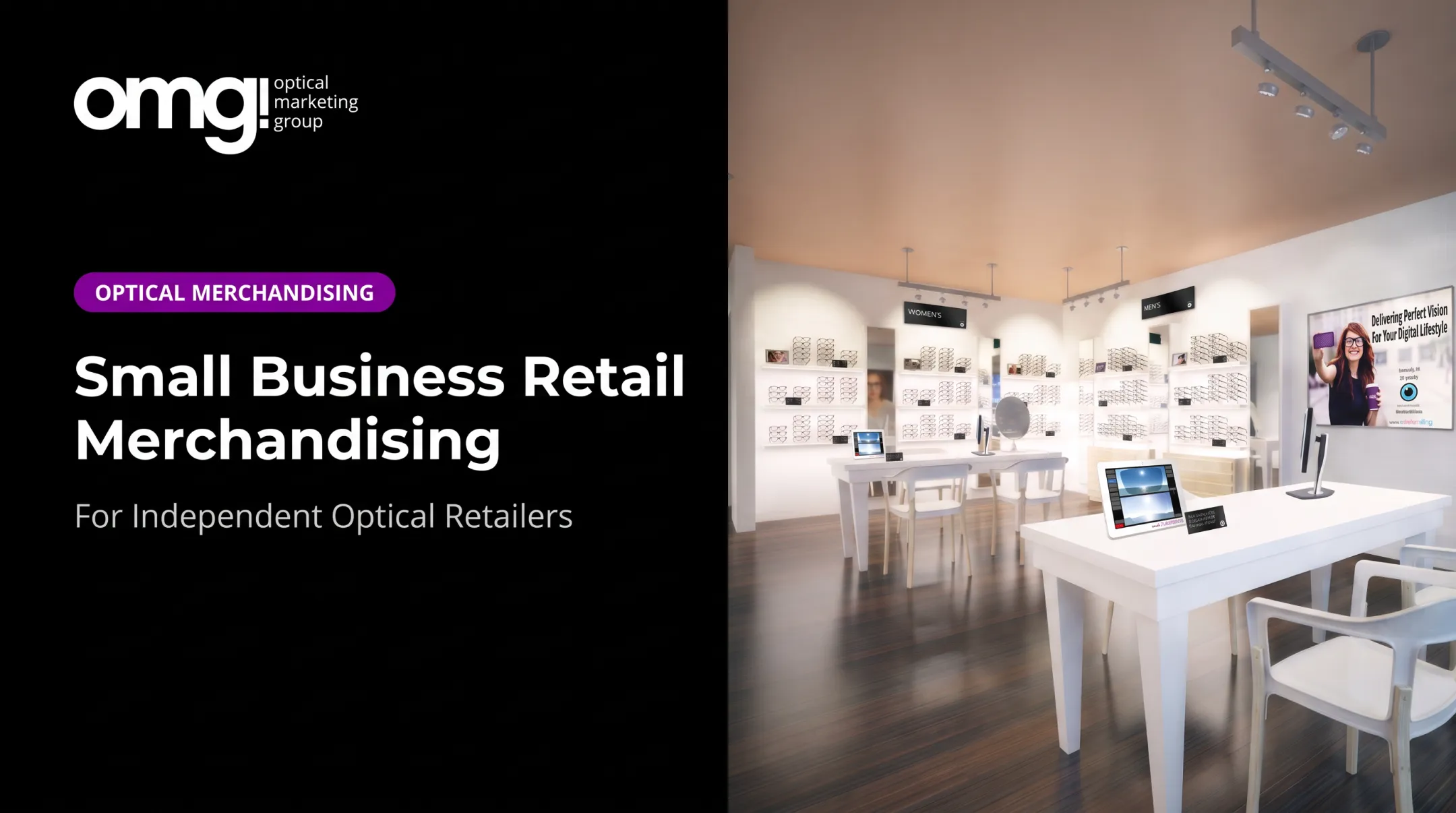
This is where OMG! Optical Marketing Group operates. Its multidisciplinary team combines space planning, custom fixtures, branded graphics, signage, digital displays, and installation support specifically for eyecare environments. For practices unsure where to start, OMG!'s Patient Experience Assessment reviews nine areas (from signage visibility to lighting quality) on a simple scoring scale, giving a baseline before committing to a larger redesign.
Applying Visual Merchandising to Optical Retail
Optical retail carries a unique tension: it has to feel clinically trustworthy and function as an easy-to-navigate retail space. Patients aren't just shopping — they're often making a decision tied to their health, comfort, and daily routine.
Mapping the Patient Journey
Every stage has a different visual job:
- Curb appeal and entry — signal professionalism without feeling sterile
- Reception and browsing — invite pre-appointment exploration, not a waiting-room standstill
- Frame selection — make comparison easy without overwhelming density
- Consultation and checkout — reinforce trust and support add-on decisions
One practice owner described patients who "all stop on the threshold" when entering a newly designed optical space — a small but telling sign that the entry itself is doing its job.
Frame Display Guidance
Industry guidance recommends grouping frames by customer need, style, material, or price — never all mixed together. Keep sightlines open and frames easy to handle. A 2025 optical trade guide also recommends 20/20's merchandising tips to place showcase frames on risers rather than flat surfaces, and to limit density so patients can actually compare options instead of feeling buried in choices.
This is a direct contrast to the traditional "soldier-on-the-wall" frame board approach. Open shelving with strategic risers and integrated backlighting tends to showcase eyewear design far more effectively than packed, uniform rows.
Signage That Supports Discovery
Signage should answer the questions patients are often too shy to ask out loud: What's the difference between lens options? What does this warranty cover? Concise, well-placed signage reduces staff repetition and builds patient confidence before they even sit down for a consultation.
Lighting and Fixture Considerations
Optical lighting has to do double duty — accurate color rendering for frame evaluation, and controlled glare so patients can actually see themselves in the mirror without a harsh reflection. Fixtures should allow secure presentation, comfortable circulation, and visibility from multiple angles, since patients often view frames from different distances before deciding.
Supporting Multiple-Pair Sales
Smart layout presents logical combinations — everyday eyewear, sunwear, occupational lenses, accessories — without pressuring the patient. This is less about upselling and more about simply showing patients options they didn't know to ask for.
Digital signage fits naturally here too. Practices using managed digital signage, such as through Contentlinq, can rotate brand storytelling, lens education, and seasonal promotions while keeping content consistent with the physical space — without needing in-house IT support to manage it.

What to Measure After Changes
- Optical capture rate
- Frame-category engagement
- Multiple-pair purchase rate
- Average optical transaction value
- Time spent browsing
- Patient satisfaction
Quick self-check for any optical space: Can patients tell where to browse? See products clearly? Move comfortably? Compare options side by side? Find helpful information without asking? Transition naturally into a consultation?
If the answer to any of these is "not really," that's the starting point for a refresh.
Frequently Asked Questions
What does a visual merchandiser do?
A visual merchandiser plans and coordinates how products and spaces are presented, including layout, displays, lighting, signage, and fixtures, to improve customer experience and support sales goals.
What is visual merchandising in a retail store?
It's the strategic use of a store's environment and product presentation to attract attention, guide movement, communicate brand value, and encourage purchasing decisions.
Why is visual merchandising important for retail?
It shapes first impressions, makes products easier to discover, reinforces brand consistency, and directly affects measurable performance like conversion and average transaction value.
What are the main elements of visual merchandising?
Layout, product placement, displays, lighting, color, signage, fixtures, storefront presentation, and digital or interactive elements all work together as one system.
How can visual merchandising improve an optical practice?
Thoughtful frame presentation, patient-friendly signage, clear sightlines, and appropriate lighting make the optical area easier to browse while reinforcing clinical trust and brand identity.
How often should a retail display be changed?
Frequency depends on inventory turnover, seasonality, and campaigns : some optical showcases get refreshed monthly, while overall display concepts might only need reconsidering every few years. Regular audits matter more than a fixed schedule.