
For many practices, striking this balance is a challenge. How do you create a space that feels both trustworthy and exciting to shop in? This article explores how to use retail graphics to transform your practice, covering the essential types, design principles, implementation strategies, and methods for measuring success.
Key Takeaways
- Effective visual merchandising graphics prompt a specific customer action, whether it's entering, browsing, learning, or buying.
- Coordinate exterior, interior, educational, and promotional graphics to create a seamless patient journey through your practice.
- Focus on clear hierarchy, readable messaging, and consistent branding rather than filling every available surface with visuals.
- Track commercial outcomes and patient experience to guide when and how you refresh your graphics for maximum impact.
What Are Retail Visual Merchandising Graphics?
Retail visual merchandising graphics are the printed, dimensional, illuminated, and digital elements that communicate with patients in and around your optical space. This includes everything from window clings and wall murals to wayfinding signs and digital displays.
Unlike simple decoration, every graphic should have a clear purpose. Is it meant to grab attention, orient a new visitor, tell your brand story, or drive a specific promotion? In an optical setting, graphics can make a dispensary feel more approachable and modern while reinforcing the expertise, quality, and clinical trust your patients expect.
According to our internal data, less than 5% of optical retailers have a cohesive signage strategy, leaving patients to navigate product categories and services on their own. A strategic graphics plan typically integrates four key areas:
- Exterior and entry graphics that create a strong first impression
- Layout and wayfinding graphics that guide patient flow
- Interior environment pieces that set ambiance and tell your story
- Point-of-purchase displays that educate and convert at the decision point
How Retail Visual Merchandising Graphics Influence the Optical Customer Journey
A thoughtful graphics strategy maps directly to the path a patient takes through your practice, from the moment they see your storefront to their conversation at the dispensing table.
Curb Appeal and Entry
It starts outside. Exterior signage, window campaigns, and clear service information invite people in. Your windows are a major opportunity to attract passersby with large-format graphics and displays that communicate what your practice offers before they even open the door.
Once inside, reception graphics should set expectations, reinforce your brand promise, and eliminate any confusion about where to check in or begin browsing.
Navigation and Discovery
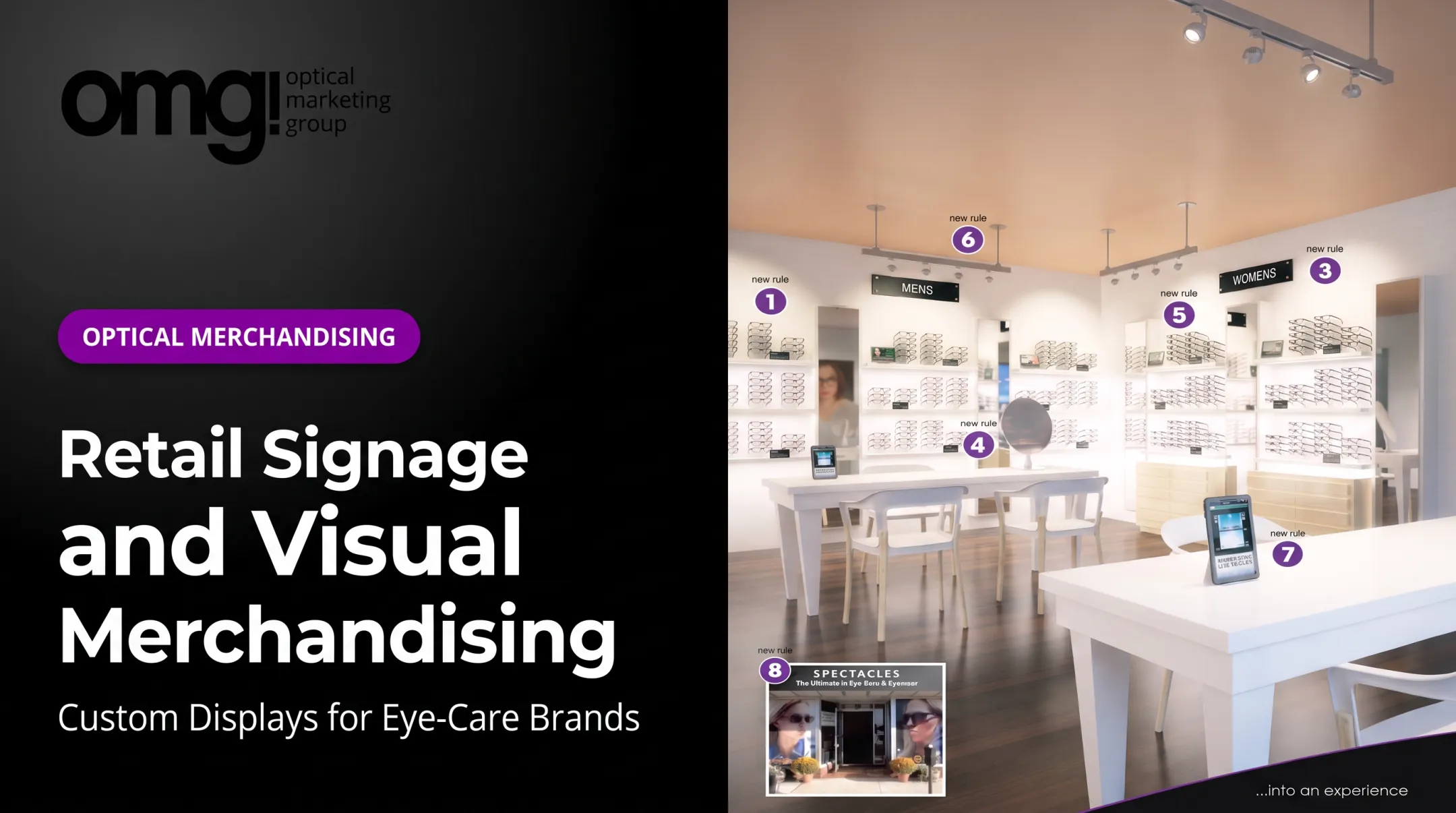
Intuitive movement is critical. Category signs, floor cues, and directional graphics help patients navigate between frames, sunglasses, specialty products, and service areas without feeling lost. This allows them to browse independently and comfortably. Well-placed signs for "Men's," "Women's," and "Kid's" sections or specific brands make the discovery process feel natural.
Education and Informed Decisions
Graphics can simplify complex topics like lens benefits, coatings, or contact lens options. A well-designed educational panel or interactive screen can explain features and benefits without overwhelming the patient, empowering them to ask more informed questions. This visual support helps your staff start meaningful conversations rather than basic explanations.
A practitioner report in the Review of Optometric Business highlights this effect. After a renovation made the optical more visible and easier to navigate from the entrance, Bellaire Family Eye Care saw a 31% increase in overall optical revenue. While the redesign included more than just graphics, it shows how an improved physical environment encourages browsing and engagement.
Point-of-Purchase and Conversion
Graphics at the point of purchase or in the consultation area prompt action, giving opticians a helpful third-party tool to initiate sales discussions. Common formats include:
- Counter cards highlighting premium lens upgrades or warranties
- Small signage prompting second-pair or backup-pair offers
- Digital screen content that reinforces in-person conversations

Types of Retail Visual Merchandising Graphics and Where to Use Them
Different graphics serve different functions. Matching each type to the right location strengthens your visual merchandising strategy.
- Exterior and Window Graphics: Use them for storefront identification, seasonal campaigns, opening hours, and brand imagery that invites people in.
- Wall Graphics and Murals: Large-scale imagery, brand mission statements, or lifestyle photography can create a powerful focal point. These elements establish your practice's personality without competing with frame displays.
- Wayfinding and Category Signage: Overhead signs, aisle markers, and fixture labels make the dispensary easy to browse. Clear wayfinding cuts patient confusion and frees up staff time.
- Educational and Product Graphics: Use these to help patients make smart choices. Lens comparison panels, feature callouts on displays, and concise brand stories can demystify technical products and build purchasing confidence.
- Promotional and Point-of-Purchase Graphics: Small-format signs, counter cards, and digital screen callouts support campaigns. Highlight seasonal promotions, second-pair savings, or add-ons without visual clutter.
- Digital and Illuminated Graphics: Backlit displays and digital screens let practices update messaging often. Use them for brand videos and rotating promotions, and manage brightness so content stays on-brand.
Design Principles for Effective Optical Retail Graphics
Great graphics aren't just about looking good; they're about communicating effectively. A recent survey by The Harris Poll found that 84% of consumers say signage directly influences their purchase decisions, while 75% agree that chaotic signs make a business seem less credible.
Establish a Clear Visual Hierarchy
Guide the patient's eye. Use size, contrast, placement, and whitespace to draw attention first to the primary message (e.g., "50% Off Second Pair"), then to supporting details, and finally to the desired action.
Keep Messages Concise and Readable
Patients are often scanning, not reading. Use short headlines, plain language, and legible fonts. Ensure sufficient contrast between text and background, and consider viewing distances. Per the 2010 ADA Standards, signs must have a non-glare finish and use conventional, non-decorative fonts for maximum legibility.
Use Color and Imagery with Purpose
Your brand's color palette and photography style should be consistent and intentional. Whether you want to convey premium quality, energetic fun, or clinical trustworthiness, your visual choices should support that goal. Focus on high luminance contrast for readability rather than relying on unproven claims about color psychology.
Connect Graphics to Your Brand Story
Every graphic is a chance to reinforce your brand. Consistent use of your logo, fonts, materials, and tone of voice across the storefront, dispensary, and digital channels builds a strong, recognizable identity.
Design for the Physical Environment
A graphic that looks great on a screen may fail in the real world. Consider sightlines, lighting conditions, reflections, and traffic flow. Ensure graphics don't obstruct frame visibility or block important safety information. Before approving any graphic, ask these five questions:
- Who is it for? (e.g., a new patient, a parent)
- What should they understand? (e.g., this brand is high-tech)
- What action should follow? (e.g., ask an optician a question)
- Where will it be seen? (e.g., from the street, at the counter)
- How long will it remain relevant? (e.g., one season, permanently)
Building and Implementing a Retail Graphics Strategy
A successful graphics program starts with a plan. It starts with understanding your goals and ends with a system for consistent execution.
Build the program in four steps:
Audit the current environment. Walk the practice as a new patient would. Note storefront visibility, patient flow, and inconsistent messaging. Spots where staff keep answering the same navigational questions are prime signage opportunities.
Tie graphics to business goals. Decide whether you need to improve browsing, launch a new location, or refresh a dated dispensary. Goals drive type and placement. Urban Optics in Texas remodeled with a new layout, fixtures, and digital signage and raised its capture rate from 42% to 72%.
Create a brand and content system. Lock approved colors, fonts, imagery, and sign templates. Multi-location practices especially need centralized standards and adaptable templates so the brand stays cohesive while local details stay relevant.
Coordinate graphics with space, fixtures, and lighting from day one. An integrated optical design partner like OMG! Optical Marketing Group can connect graphic design with practice layouts and custom fixtures so every element supports the patient experience.

Measuring and Maintaining Performance
To understand what’s working, define a measurement plan before you install new graphics. Combine commercial indicators with experiential feedback.
Commercial Indicators:
- Optical capture rate
- Sales of featured products or brands
- Multiple-pair sales
- Response to specific campaigns
Experience Indicators:
- Reduction in navigational questions from patients
- Staff feedback on conversation starters
- Observed changes in patient dwell time and browsing behavior
A large-scale study published in the Journal of Marketing found that digital signage increased the likelihood of purchasing a featured product by 8.1% in general retail settings.
Where possible, compare performance before and after a graphics change. Document the objective for each graphic so you can interpret the results accurately.

Pair that measurement with routine maintenance. Regularly check for:
- Damaged graphics
- Outdated offers
- Cleanliness issues
Base refresh timing on business needs, not a fixed calendar. Update graphics for seasonal campaigns, product launches, brand changes, patient feedback, or performance data.
An assessment tool such as OMG!’s Patient Experience Assessment can help spot ongoing opportunities across signage, traffic flow, and the broader retail environment.
Frequently Asked Questions
What are retail visual merchandising graphics?
They are the physical and digital graphics used in a retail space to attract attention, communicate information, guide movement, support product discovery, and reinforce a brand’s identity.
What types of graphics are used in retail visual merchandising?
Common types include window and wall graphics, wayfinding signs, educational panels, point-of-purchase displays, and digital or illuminated screens. In optical, these help categorize frames, explain lens benefits, and promote offers.
How do retail graphics influence customer behavior?
Purposeful placement, clear messaging, and strong visual hierarchy can capture attention, simplify navigation, improve product understanding, and prompt conversations with staff that lead to a purchase.
How can visual merchandising graphics improve an optical store?
They can make a practice feel more welcoming, simplify frame discovery, educate patients on complex products, and elevate brand perception. This contributes to better traffic flow and increased opportunities for optical capture.
What should be included in an optical retail graphics strategy?
A complete strategy should include an audit of the current environment, a map of the patient journey, brand standards, content rules, and a plan for installation, measurement, and accessibility.
How often should retail graphics be updated?
Updates should follow business needs, such as campaign schedules, product launches, or store renovations. Performance data and patient feedback are better guides than a fixed universal interval.